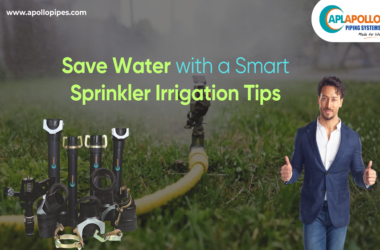
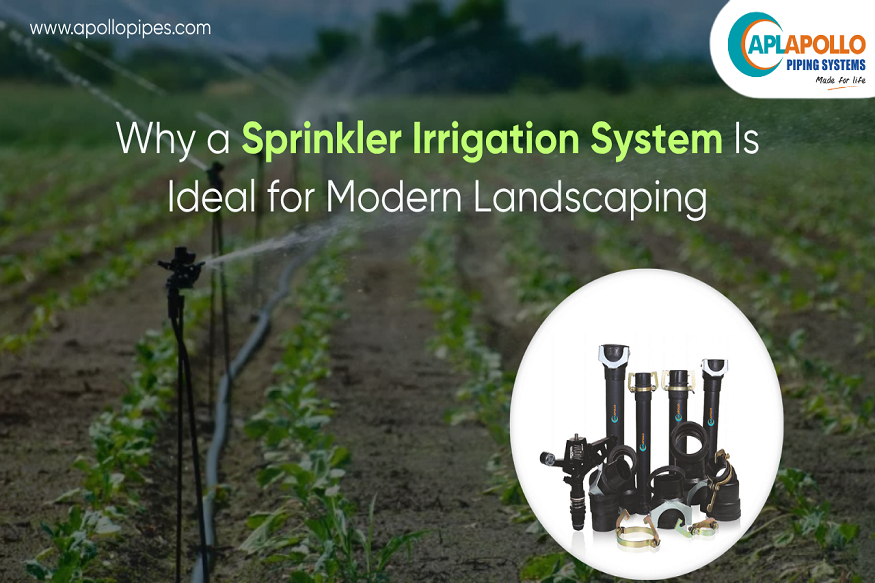
Modern landscaping is about more than creating attractive gardens and green spaces. It also involves maintaining plants efficiently while making responsible use of water, time, and resources. Whether it is a residential lawn, a commercial property, a public park, or a large landscaped development, the right irrigation method plays an important role in keeping vegetation healthy and visually appealing. A sprinkler irrigation system offers a practical approach by distributing water across a designated area in a way that resembles natural rainfall. With suitable planning and installation, sprinkler irrigation can make landscape maintenance more convenient, consistent, and water-conscious.
These Features Make Sprinkler Irrigation System Ideal for Modern Landscaping
l Efficient and Uniform Water Distribution
One of the key advantages of sprinkler irrigation is its ability to distribute water across a defined landscape area. When sprinklers are correctly positioned, water can reach lawns, garden beds, and other planted areas more consistently than manual watering with a hose or bucket.
Uniform distribution can also help avoid areas receiving too much or too little water, provided the system is appropriately designed for the landscape.
Read More: What Questions Should You Ask Before Buying an RO Plant?
l Better Water Management and Reduced Wastage
Water management is increasingly important for modern landscaping. A well-planned sprinkler system allows water to be directed toward areas that actually need irrigation. This can reduce unnecessary watering of pathways, hard surfaces, and other non-planted areas.
The amount and frequency of irrigation can also be adjusted according to plant requirements, weather conditions, and soil characteristics, helping users make more responsible use of available water.
l Suitable for Small and Large Areas
Sprinkler irrigation is adaptable to different landscape sizes. A compact residential garden may require only a simple arrangement of sprinklers, while larger properties can use multiple irrigation zones to cover extensive areas.
This flexibility makes sprinkler systems useful for everything from home lawns and gardens to parks, resorts, sports facilities, and large landscaped developments.
l Convenient and Time-Saving
Traditional watering can require considerable time and regular manual effort. A sprinkler system can simplify this process by delivering water through a planned network rather than requiring someone to move a hose around the property.
Depending on the system design and controls used, irrigation can be scheduled or operated in zones, making landscape maintenance more convenient for homeowners, gardeners, and facility managers.
l Adaptable to Different Landscapes and Soil Conditions
Every landscape has different requirements. Soil type, plant selection, slope, sunlight exposure, and the size and shape of the area can influence irrigation needs.
A properly designed sprinkler irrigation system can be configured to suit different landscape layouts and irrigable soil conditions. Selecting appropriate sprinkler outlets, pipe arrangements, and operating schedules is important for achieving effective coverage.
l Supports Healthier Lawns, Plants, Trees, and Gardens
Plants need an appropriate supply of water for healthy growth. Consistent irrigation can help maintain lawns, ornamental plants, trees, flower beds, and gardens, particularly during periods when natural rainfall is insufficient.
By delivering water more systematically, sprinkler irrigation can contribute to a healthier and more attractive landscape when combined with suitable soil preparation, plant selection, and overall garden maintenance.
l Reduces Manual Effort
For larger landscapes, manually watering every section can be particularly demanding. Sprinkler irrigation reduces the need for repetitive watering tasks and can make routine landscape care easier. This is especially useful for properties where maintaining consistent irrigation across numerous planting zones would otherwise require significant labour.
Applications of Sprinkler Irrigation
A sprinkler irrigation system can be used across a wide range of settings. In residential properties, it can help maintain lawns, gardens, and landscaped outdoor spaces. Parks and public areas can use sprinkler systems to maintain large green spaces, while resorts and hotels can use them for gardens and recreational landscapes.
Golf courses and other large landscaped properties may also require systematic irrigation to cover extensive areas. Agricultural users can use sprinkler irrigation for suitable crops and growing conditions, making the technology useful beyond conventional landscaping.
Factors to Consider When Choosing a Sprinkler Irrigation System
Choosing the right irrigation system requires more than simply selecting sprinklers. Start by evaluating the size and layout of the landscape, as these determine the number and positioning of sprinkler outlets and the overall piping arrangement.
Water requirements are another important consideration. Different plants and landscape zones may require different amounts of water. Soil type should also be assessed because water infiltration and retention can vary between soils.
The quality of pipes and fittings matters as well. Durable piping can support reliable system operation, while suitable joining methods can help minimize leakage. Installation requirements, maintenance access, water pressure, and overall system efficiency should also be considered before installation.
Read More: Why Digital Signage is Essential for Modern Event Experiences
A carefully planned system should balance coverage, water requirements, operating convenience, durability, and installation considerations rather than focusing on a single feature.
APL Apollo’s Sprinkler Irrigation System
TheAPL Apollo sprinkler irrigation system is designed to provide uniform and smooth water distribution with a focus on efficient water use and coverage for both small and large areas. According to APL Apollo, the system is adaptable to irrigable soils and is suitable for residential, agricultural, industrial, hotel, resort, public and government, golf-course, and race-course applications. Its listed advantages include easy handling, transportation and installation, chemical resistance, non-conductive properties, better flow and leak-proof joining, high strength and durability, and UV stabilization. The company also provides technical information for its HDPE pipes, including product options covered under specified Indian Standards, making the system a consideration for users looking for a practical piping solution for diverse irrigation requirements.